Wednesday, August 3, 2011

Kata Tjuta and Uluru, The Red Centre

Uluru waterfalls!

G'day!

Probably everyone has heard of Ayers Rock now known by its Aboriginal name Uluru.  But most of the tours offered are for 3 days to Uluru/Kata Tjuta/Kings Canyon.  I had never heard of the other 2 places but they must be grouped for a reason.  So I booked my tour with The Rock Tour for $355 (all inclusive).

I was picked up just after 6 am in front of my hostel, Alice Lodge Backpackers (no incidents this time).  An hour later, we headed south on the Stuart Highway.  Uluru-Kata Tjuta National Park is 450 km/270 miles from Alice Springs so much of the first and last day is spent traveling on the Stuart Highway.  We stopped in Curtin Springs to buy beer since alcohol is unavailable in the park and stopped along the Highway to pick up firewood.

The many heads of Kata Tjuta
Normally there are 21 people on a tour, but this year, the numbers are down.  It's probably partially due to all the weather/water related incidents in the news earlier in the year.  The other major factor is that Tiger Airways' planes were grounded.  Tiger and Qantas (very expensive) are the major carriers into Alice Springs while Qantas and Virgin Blue fly mostly internationally into Yulara, Ayers Rock Resort.

We had to drop 7 of our passengers off at Yulara because Tiger was grounded while they were on their Rock Tour and they had to scramble for new itineraries.  We picked up 2 passengers for our tour so our final number was 10 guests.  Rachelle was our intrepid guide.  My tour mates were Christine and her sons Andrew (26) and David (13) from Melbourne, Elizabeth (Irish), David (British Israeli) and 2 pairs of French girls (all mid - late 20s).

View from Karingana, the second Kata Tjuta overlook
The traditional owners of Kata Tjuta and Uluru are Anangu and the Australian government handed the lands back to them 25 years ago in 1985.  Since then, while the Anangu welcome visitors, they also stress that the places are important and sacred to their culture.  Uluru-Kata Tjuta National Park is World Heritage listed for its natural values and as a living cultural landscape.

Tjukurpa is the Anangu story of creation that is taught and remembered through songs, stories, dances, rock art, and objects to the right people.  Some of this knowledge are rituals for men only or for women only; some are only for those who inherited the right to the knowledge or earned it.   Kata Tjuta is a sacred place for Anangu men and none of its creation stories are shared.

We had to climb this smooth slippery area -
good thing it wasn't wet
Access to some areas are restricted to certain people so visitors must stay on the marked tracks.  Several areas of Uluru are signposted (and on the map) as sensitive and photos are not allowed.  If caught by park rangers, violaters would receive a fine and have their pictures deleted or film destroyed.

Our first stop was Kata Tjuta or The Olgas after the tallest mountain (1066 meters/3500') in the group.  Kata Tjuta means "many heads" in the Pitjantjatjara language, an apt description of the 36 steep dome-shaped rock formations.   Kata Tjuta is of sedimentary conglomerate rock held together with sandstone and the weathering has made the area unusual.

Looking back from Karingana
We did the full circuit of the Valley of the Winds walk, (7.4 km/4.5 miles, 3 hours) steep, rocky and difficult in places.   The walk to Karu, the first lookout, is pretty easy and the view is nice.  But the view from Karingana, the second lookout, is spectacular.  It's more difficult to get up there if it's hot but it was fairly cool and overcast when I was there.  When the temperature is 36*C (97*F) the track is closed after the first lookout.

We went to the Uluru tourbus sunset viewing area.  The area is between Kata Tjuta and Uluru (25 km/16 miles apart) and the sun sets behind Kata Tjuta.  What we are meant to see is the reflection of the sunset off of Uluru.  To really see the sunrise/set color effect, I think one needs to be closer to the rock than we were.

Can you see an elephant?
We ate our chicken and pasta dinner which Rachelle cooked over gas burners.  The park ranger pointed out a dingo before he made sure we left the area.  Not too many dingo sightings, so we were lucky.

Ayers Rock Campground is equipped with hot showers and toilets but the lights in the women's side didn't work (same thing at Kakadu - interesting).  And it was COLD so most of us stayed "grotty" (grotesque) and "manky" (stinky?) the whole time.  


Sunrise:  Uluru is to the right
Us newbies were introduced to our swags.  A swag is of waterproof canvas and foam padding and lined to make a sleeping bag holder.  You zip yourself into your sleeping bag and then zip up the swag.  There's a flap that you can pull over your head.  It's designed so that it doesn't touch your face but protects against rain, etc.

We slept under the stars in a circle around the campfire.  Too cold for mossies.  I got teased because my sleeping bag from home is rated to 20*F/-6.5*C.  (Thanks to shoulder season high altitude Utah camping - too hot and crowded in summer.)

The Rock Tour bus
With sweats, socks, arctic sleeping bag and swag, I was warm.  I didn't hear or feel the mice.   What?! Mice?  Yep, that's the etc., lots of little mice running around.  Heard a couple of stories in the morning about mice on and IN the swags.  Heard and felt the rain though.  I don't care what anyone sez, it was rain, NOT mice, on my swag!

Rise and shine at 6 am to roll our swags tight and break camp to go see the sunrise by Uluru.  We went back to the sunset viewing area, saw the sun rise next to Uluru, and enjoyed the brilliant colors in the sky.

The Anangu, "Don't climb Uluru."
Finally, what we all specifically came for: Uluru up close.   Uluru truly is awesome.  It is unusual because of its massive size, homogeneous composition of coarse grained arkose, a feldspar sandstone, and its lack of jointing.  So it looks like a monolith with little evidence of erosion in scree slopes or soil on it.   Most of its bulk is underground.  Its highest part is 348 meters/1142' and its circumference is 9.4 kilometers/5.8 miles.

While visitors are allowed to walk all around the base of Uluru, there are several reasons why they are discouraged to climb Uluru.   The most important reason, for me, is that it is a sacred place for the Anangu and they don't want anyone to climb it.   They have decided to lead by example and no longer do their ritual climbs.
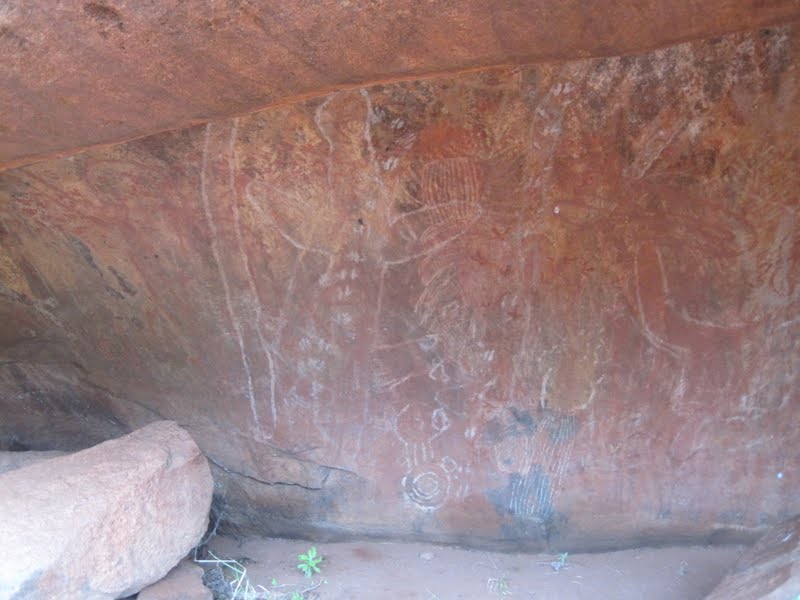
Uluru rock art
Another reason is the bad fortune that has befallen people who have climbed or taken a rock from Uluru, or taken a picture of a sensitive site.  A "sorry book" in the Cultural Centre is full of letters from all over the world apologizing and/or sending back mementos.

And if those reasons are not enough, at least 35 people have died while attempting the dangerous climb.  Apparently the most accessible place to climb Uluru is on the western face.  A knee-high post and chain line on part of the face is visible from the carpark.  That's only 1/3 of the climb.  The climb is closed during adverse weather conditions and for important cultural reasons.

Doesn't the pattern on the far left look like a brain?
However, there are visitors who come with the goal of climbing Uluru and many are not dissuaded by any of the above reasons.  Some of the 100,000 annual climbers leave human waste including nappies and rubbish on Uluru which cascade down after rainfall.  Despite lengthy discussion to ban climbing, the joint governing board has not made the highly controversial move.

A ranger-guided walk (included in $25 park entry fee) that teaches about Anangu culture and the significance of Uluru is available daily at the Mala Carpark.  But we had Rachelle who told us everything we needed and wanted to know.  I am impressed with the professionalism of Aussie tour guides.  Tourism is big business and the guides really know their stuff.
Lungkata, the blue tongue lizard man

One Tjukurpa story is about Lungkata, the blue-tongue lizard man.  Lungkata, while hunting around the southern base of Uluru, killed an emu that others had speared and started cooking it.  He hides the emu meat and lies to the two hunters when they see his fire and confront him, saying that he has not seen the emu.

The two hunters find and read the tracks, deduce what has happened, and go after Lungkata.  Lungkata gathers up the meat and runs up towards his camp, a cave up on the western face, dropping chunks in his rush.  But Lungkata is soon caught and burned in a huge bonfire.  The smoke and ash still stain the side of the rock (it is very clear and IS in the shape of a lizard), the emu's thigh is visible closeby, and the boulders below are chunks of emu meat.  So the Lungkata story also teaches against lying and stealing.

The Mala Walk is probably the most popular walk because of easy access to one of the two waterholes at Uluru, rock art, and caves and rock formations whose creation story is allowed to be widely shared.

After Rachelle gave us our interpretive Mala Walk (2 hours) we finished the Uluru Base Walk, a 10.6 km/6.4 miles loop (another 2 hours).  During our walk, it sprinkled on and off; the downpour began just after most of us had returned to the minibus.

After lunch, we visited the Cultural Centre for an hour.  Heaps of information on history, kinship and relationship, geology, land management, weather, food and medicinal uses of flora, fauna and insects, arts and crafts, the "sorry book", and more.

The footprint of Lira, the poisonous snake made
during the battle with Kuriya, the woma python
After an hour and a half of heavy rain, the waterfalls on Uluru were flowing!  Only about 15% of visitors get to see the waterfalls as rain is sparse, about 30 cm/12" annually.  We splashed through the rain to take pictures; even Rachelle was thrilled and took lots of pix.  Then we drove all around Uluru.

Uluru is an Australian icon and deservedly.  Kata Tjuta is just as deserving but how many icons can a nation have.  But because of its proximity to Uluru, hopefully most visitors will also enjoy Kata Tjuta.  You'll get the rest of my adventure next time.

Cheers!
Cyn


Saturday, July 23, 2011

The Ghan, Katherine and Alice Springs

G'day!

Plane, train, bus, or automobile to Alice Springs to see Uluru/Ayers Rock?  I chose the train and bought a Rail Explorer pass ($450) which allows unlimited travel on Great Southern Railways routes for 3 months.  There's a $10 fuel charge for every trip I book and a $50 cancellation fee if I don't travel on a booked ticket.  The Ghan travels between Darwin and Adelaide twice a week in each direction.  The Indian Pacific goes between Sydney, Adelaide and Perth while The Overland plies between Adelaide and Melbourne.

The outback - view from The Ghan
So I took a cab ($12) with 3 other girls from Dingo Moon Lodge to the railway station, 20 minutes from the CBD.  I checked in on Sunday 8 am, an hour before departure and checked my backpack (2 pieces under 20 kilos each allowed).  My arrival time in Alice Springs (1500 km/930 miles) was scheduled for Monday 11:30 am (27.5 hours).

There are 3 levels of service on the Ghan: Platinum, Gold, and the one I took, Red.  I was in a Day/nighter seat which reclines somewhat.  The Red Service dining car, the Matilda Cafe, serves reasonably priced and pretty good meals and snacks and overpriced drinks.  A lounge car ($10/day) provides free coffee and tea and power points (outlets) for electricity.  Red service sleepers are available for $150/night.  You can bring your own anything except alcohol.

Cruising in Katherine
I was excited about my train ride.  I would get to see the countryside, the renown barren, wide open outback!  And I did!  Miles and miles and miles and miles and miles and miles of it!!  Actually, it is amazing how huge and empty of humans so much land can be.  And the land was not all flat as I expected.  There were little hills here and there, little lakes (billabongs?) and creeks and creek beds. The ground was often very red (iron) and sometimes white, yellow, or brown.

The vegetation was mostly low shrubs and grasses.  Sometimes there were small trees, rarely large trees.  I saw cattle and lots of birds including an emu running.  From time to time, I could see B-trains (3 trailer big rigs), campers, and cars on the Stuart Highway which runs parallel.

Katherine Gorge
We had two very long stops on the way to Alice Springs.  The first was a 5 hour stop in Katherine.  Whistle stop tour options are outlined on the Ghan magazine, Platform.  I chose the 3-hour Two Gorge Cruise for $85.  It was all very well organized.

 A tour bus took us to the gorge where we transferred onto two flat bottomed boats.  A tour guide explained the formation of the gorges and described some of the local plants, birds, and animals.  The cliffs, rocks, and water were beautiful.  We saw two crocodiles, a croc trap, and beaches where the crocs nest.  We got off the boat to see some old Aboriginal rock art and to walk to another gorge where we boarded a second boat.  The second boat cruised partway up Katherine Gorge.  Then we went back the same way. It was a pleasant way to spend our stopover.

The other long stop was in Tennant Creek around midnight for about 6 hours.  Apparently freight trains have higher priority than passenger trains.  I'm not sure if the Katherine stop was for freight or not.  I think and hope it was.  If it weren't for those 2 stops, the trip would be 16 hours.

The train ride was very nice.  Each of the 2 Red Service cars has 64 seats.  Passengers are able to turn the row of 2 seats around to face each other.  Since my car was almost empty, I not only had the seat next to me available but the two in front of me as well.  I did some reading, some sudoku, wrote my Darwin blog post, and ate a lot of snacks.  I even took a shower since 2 showers with bath towels (and 2 toilets) are available on each car.  Sweet.

We arrived in Alice Springs a few minutes late.  I was picked up by the Alice Lodge shuttle.  After checking in ($26/3 bed), I walked into town to pay the balance for my 3 day Rock Tour to Uluru, Kata Tjuta, and Kings Canyon.  Unfortunately, I had just missed one of the biggest events of the year, the Alice Springs Camel Cup races.  I did enjoy the weekly Sunday market on Todd Mall.

Alice Springs, about halfway between Darwin and Adelaide, is called the Red Centre (Center) and is very close to the actually geographic center of Australia.   "The Alice" is the second largest town in the Northern Territory (after Darwin) with 28,000 residents.  But, I'm sorry, "there's no there there".

It's not a pretty town.  It's not a busy town.  I was told by at least 10 people during the course of my stay in Alice that it is not safe for anybody to walk around after dark, not even for 2 blocks.  There are regular opportunistic robberies, beatings, and even rape that occur throughout Alice.  The problems are blamed on Aborigines.
Alice Springs from Anzac Hill

I've spoken with several people about Aboriginal culture.  My Kakadu guide, Nifty, and my Rock Tour guide, Rachelle, were the most knowledgable and positive about them.   The gist of what I learned is that Aborigines have been the keepers of their land for tens of thousands of years and prefer to live as they have always lived without Balanda (non-Aboriginal) influence.  But of course that is impossible.

The Australian government has handed back large parcels of land back to the traditional owners.  Many national parks are on land that was handed back and the Australian government have 99 year leases which are paid to the Aboriginal groups.  Royalties for mining leases are also paid.  There's a huge uranium mine in Kakadu.

Traditionally Aborigines only worked to get food, shelter and clothing; working at a "job" is not part of their culture.  These days, with supermarkets and clothing stores, all they need is $$.  I don't know how land lease or mine royalty payments are distributed nor to whom.  But many Aborigines are unemployed and are "on the dole" (welfare).  Some people (including Aboriginal leaders) say that Aborigines have lost their self respect because they don't have to work.  Some say that the Australian government has made it worthwhile or too easy for Aborigines to be unemployed.

Eucalyptus pachyphylla - Red bud mallee
However, other Aborigines make a living off tourism.  They continue their traditional work such as making clothes, bowls, weapons, and musical instruments which are sold as art.  Painting is now mostly on canvas instead of on wood, bark, or rock and is also widely sold.  Still others become  park rangers or guides.  Also, many Aborigines are fully integrated into Australian culture and there is some intermarriage.

Alcohol is a major problem.  Aborigines are unable to process alcohol well, just like the Chinese and Native Americans Indians.  Yet many drink.

Aboriginal culture has many rules about kinship based on "skin grouping", gender and tribe that affect how they interact with each other.  Some relationships prohibit any contact with certain people.  So if they know one of them is in the supermarket, they must wait outside until that person (people) leaves.  So it appears that Aborigines loiter in the street.

Eremophila - Emu or Fuchsia Bush
Aboriginal culture have (harsh and brutal) traditional punishments.  Traditional punishment for a fairly minor infraction would be a spear in the thigh which the victim was not allowed to remove; it has to fall out naturally.  The shaft would be made of mulga wood which is toxic so healing time was prolonged.

These punishments are still meted out.  Apparently, in Darwin and Alice Springs, one can see boys and men limping about.  A more severe punishment would be to take the victim to the top of a mountain and put sap of a certain reed into their eyes which causes (temporary?) blindness.

I felt safe walking in Darwin.  I had been to the Botanical Gardens and stopped by the Mindil Beach Market for dinner.  I didn't see any of my hostel mates so I walked home alone, after dark, on mostly deserted streets to my hostel 25 minutes away.  No worries.

Euro in Olive Pink Botanical Garden
I felt safe walking in Alice Springs during the day.  There are usually tourists on Todd Mall, Anzac Hill, and in the two supermarket shopping centers.   I walked alone in a fairly remote/open area one morning to the Olive Pink Botanical Gardens.   The only time I felt uncomfortable was on a cloudy late afternoon;  the streets were deserted.  I was spooked and decided not to go to the Royal Flying Doctors Service and School of the Air museums.  I took a cab home after dinner one evening.

The Botanical Gardens looked natural.  There were a whole bunch of different birds out there and I saw a euro, a type of wallaby, in the rocks.  I especially enjoyed the mallee, bush medicine, and Eremophila (Emu or Fuchsia Bush in the Scroph family) areas.

I visited Ayers Rock!  Details next time.
Cheers!
Cyn

Friday, July 15, 2011

Kakadu Safari

Namanjolg and Namarrgon, Lightning Man 
G'day!

I booked a 3 day/2 night trip with Kakadu 4WD Safaris ($510 all inclusive).  My adventure started with a 6 am pick up.  My guide, Neville aka "Nifty", put my daypack and sleeping bag into the trailer and then went over the road (across the street) to get 2 other guests.  Meanwhile, I waited on the footpath (sidewalk).

Stumpy (3 feet away) in Adelaide River


A 30ish man came out of my hostel; I had seen him walk in with a young lady 5 minutes earlier.  He walked up to me and asked me a question.  I thought I must have misheard and said, "I'm sorry, what did you say?"  He said again, "Do you want sex."  I backed away saying, "No, no!" and gaped after him as he hailed a taxi and rode away.  I was wearing a singlet (tank top - not a onesie, Stephanie) and shorts suitable for the hot weather even at 6 am and I did expect to be picked up, but just not that way!

Can you see Namanjolg's feather?
First I have to say that I had an excellent adventure primarily due to Nifty's encouraging attitude and very extensive knowledge.  He told us almost everything that I eventually read about in the visitor and cultural centers and guidebook and more.  I dubbed him a "generalogist".   And he wasn't bad to look at either.

Landforms and rock art or gunbim explain Creation stories
The 4WD Landcruiser seats 1 passenger in the front and has 2 benches holding 4 each facing inward in the back.  We pulled a trailer for our luggage, food, campgear and extra water. My safari mates were a German family of 4, Hannah (10) and Frederich (13), three German girls, and Anna from Tasmania.  Alcohol is not available in National Parks and is expensive close to the park so we stopped in Humpty Doo (!) to buy beer.

First up, a cruise on the Adelaide River to see the salt water crocodiles.  Our Aboriginal guide was Ganda who owns Kakadu 4WD Safaris.  Reese, a behavioral zoologist from the Melbourne area, provided additional commentary.  We got on a small flat bottom boat and were instructed about safety.  No one is allowed to move from one side of the boat to another.  If the croc is on your side, you stay seated and the other side may stand. No human body parts may protrude over the side of the boat at any time.

We cruised down river until we saw a croc.  Ganda stopped the boat and slapped the water with a piece of meat dangled over the water.  The croc came over and snapped at the meat.  It jumped higher until it had the meat in its mouth.  Ganda pulled on the meat and it came out of the croc's mouth.  We saw several crocs including "Stumpy", an large old croc missing his right arm and most of his teeth. He will probably lose his territory and have to move upriver or out to sea.

We're walking on the highest part of the Arnhem plateau


The croc's jaw strength is usually what kills their prey at up to 5000 pounds per square inch (350-400 psi for rottweiler or large great white shark) although the muscles for opening the mouth are relatively weak.    They normally have about 70 sharp teeth that are replaced continually until old age (about 100 years).  The "death roll" helps tears up prey into gulpable pieces.  Their powerful tail helps them jump out of the water or move quickly through the water, less quickly on land.  Thankfully, since they are cold blooded, crocs can go for months without food and are opportunistic hunters, going for "easy meat" that wanders into their territory.

Imagine the force of the water that brought this boulder here
Salties are usually striped tan and black when young.  Generally, as they age and have lived in salt water more, they turn darker so some old crocs appear to be black.  Crocodiles gained protected status in Australia in 1974 so products such as croc tail for meat, leather and teeth are harvested from crocodile farms.  On the way back to the ute we saw a Katherine brown or banded snake.

Jim Jim Falls
About 32% of the population in the Northern Territory, or Top End, is Aboriginal.  The Bininj/Mungguy have lived in Gagudju for as long as 40,000 years.  Kakadu National Park is about 250 kms (150 miles)from Darwin,  World Heritage listed as a natural as well as cultural site and is jointly managed by the traditional owners and Parks Australia.

Plants can survive and be beautiful anywhere!
Kakadu is renown for its biodiversity and internationally important wetlands for migratory birds.  We stopped at Mamukala Wetlands where we learned about the bird and plant life of the area during the 6 seasons of the Aboriginal year.  We saw magpie geese, great egrets and other birds.   At other places we saw many red tailed black cockatoos, black cockatoos, white corellas, flycatchers, whistlers, and bush turkeys.  We also saw a dingo trotting along a sandy track, a few wallabies, flying foxes, and little lizards.

As you may recall, Australia had a very wet year after 9 years of drought.  So even though June - August is Wurrgeng, the Aboriginal cold early dry season when the floodplains are drying out and the creeks usually stop flowing, it's happening later this year.  So some areas  such as Twin Falls and Gorge are still not accessible.

The only place not posted for crocs is the plunge pool itself
Saltwater crocs inhabit most areas of water in Kakadu.  Although some visitor areas in crocodile management zones are opened only after park staff have trapped and removed salties, they can move in at any time.  With so much water still here, risk is higher.  Freshwater crocs can be found in rivers, creeks, and plunge pools (the base of waterfalls).  They are usually shy but should not be approached.  Although we saw heaps of croc warning signs, we did not see any crocs.

After a quick stop at Bowali Visitor Centre and a sandwich lunch in the Nourlangie region at Anbangbang Billabong, we went to see the rock art or gunbim on the walls of Burrunggui.  Some of the art dates back tens of thousands of years to when the Mimi spirits first taught Bininj how to paint. There are naturalistic paintings of animals, traditional xray art, and paintings of European contact.

Billy can and early brekkie before our big climb
Some figures established dream stories, some were ceremonial, and some were to teach younger ones.  We could see from Gunwarddehwardde Lookout, the solitary stone on the Arnhem escarpment that is Namanjolg's feather that his sister put there after they broke the incest laws.  Namanjolg later became Ginja, the saltwater crocodile.

I was impressed with the amount of art we were able to easily see in a 1.5 kilometer area; there are about 5000 drawings in Kakadu.  The Bininj painted in the shade during the scorching hot days and while staying dry during the rains.  The rock surface in the area is coarse conglomerate sandstone.  Ubirr is the other area with spectacular rock art.

Mossie tents are a must!!!
Then we headed towards our campsite.  But we got a flat tire.  After searching all over the Landcruiser and trailer, we could not find a jack and had to flag down a car and then a ute because the car's jack was too low.  We collected firewood (partially burned trees left from land management fires) while Nifty was dealing with the jack/tire.  Then off again through the savannah woodlands to the Jim Jim Falls area which is only accessible in the dry season and only by 4WD, (by flightseeing during the wet,) eventually turning onto a bumpy red dirt road for 50 kms/30 miles (2 hours).

I don't know how this granite got on top of the sandstone
We camped both nights at Garnamarr Camping Area which had flush toilets and hot showers!  Although we were supposed to sleep in swags, we were very relieved that Nifty provided us with 3 mosquito tents instead.   We had kangeroo meat burritoes, chocolate cake!, roasted marshmallows and didgeridoo lessons by our campfire the first night.  Roasted chicken and jacket potatoes on the second night.

After the hiking in/and the heat (and with the foam mat which I folded in half and used under my shoulders to hips), I slept well.  I got into my sleeping bag in the middle of the night when I got cold.

Budjmi Lookout
We left camp by 6:40 am (late) and drove 10 km/6 miles (1 hour) over the sand/rock road to the Jim Jim Falls carpark.  The Barrk Marlam Bushwalk branches off the Jim Jim Plunge Pool track and is a "very steep, difficult 6 km return walk through the rugged stone country typical of the Arnhem Land Plateau.  Allow 4-6 hours."  Well, we made it to the top of the sandstone escarpment in a little over 2 hours.  It was worth the effort (at the time, I paid later with sore thigh muscles).  It's amazing to see the evidence of what all the water can do during the wet season and what a gorgeous view!

Fruit from Pandanus is good bush tucker
We made it down in under 2 hours and then did the 1 km return walk through monsoon forest and over boulders to the base of the falls so the Germans could have another swim.  Nifty taught us a trick.  Stare at one point of a waterfall for about 10 seconds.  Then look to the side of the waterfall.  The wall will appear to move.  It really does!  Less than one K back to the carpark!! Hot shower!!  Ah!!!!!!!!

The next morning we drove an hour to do a short steep walk up to Budjmi Lookout.  This involved crossing a creek on 3 small fallen treetrunks and hiking up the conglomerate sandstone hill.   Then we rockclimbed, searching for hand and toeholds, up the granitic rocky outcrop perched on top of the sandstone.  Strange geology.  Another great view of the escarpment we had climbed the day before and in the silence, we could hear many different bird calls.

Old Jim Jim Road is only open during the dry season - now
We bumped back to the campground to hitch up the trailer again and then drove through the Yellow Waters region to Cooinda and toured the Warradjan Aboriginal Cultural Centre.  After lunch we took Old Jim Jim Road out of Kakadu and drove miles and miles of dirt track back towards civilization.

On the way we passed through areas being burned to reduce undergrowth as the Aboriginals have always done to care for their land. We passed signs indicating areas of military training where soldiers do their war games and tanks practice.  We also had to go through a high creek; although the water level was higher than the door, water did not enter.

Giant termite mound
Our last stop was to see huge termite mounds that were more than 10 feet high; their underground network is even more extensive. There are termite mounds dotting the bush throughout the area with each colony keeping to itself.  Termites play an important role in creating habitats, soil aeration, groundwater retention, and recycling nutrients.

That's it for my Kakadu adventure.  I saw a lot and did heaps of hiking for a 3 day safari.  But I only touched the surface of what Kakadu had to offer; another 2 days would have been good (but expensive).  July is probably a very good time to be in the area because the weather is cooler and the water level is low enough to allow access yet wet enough for the waterfalls to still run.  Litchfield National Park is nearby.  So, if you can, pick up a 4WD vehicle and National Park Guides (free and very helpful) in Darwin and spend a week or so in the Litchfield/Kakadu area.

Cheers!
Cyn

Stephanie in Sydney!!

G'day mates!

Vivid Sydney Opera House
As you all probably know I (Stephanie) took a trip to Australia recently.  My adventure began with a 6 hour wait in the San Francisco airport followed by an hour plane ride to LA and another 5 hour wait for my flight to Sydney.  That wait was well worth it.  I flew standby on Delta Airways and got bumped up to first class on a 15 hour plane ride!  I was so excited and it was funny because I got to fly first class on a long flight before my dad has (teehee).

Someone fishing! across from Bondi Beach
My flight got into Sydney at 6 am.  I got through Customs and Immigration fairly quickly and took a shuttle to meet up with my mom at a hostel called Bounce.  I was incredibly excited to see my mom for the first time in 7 months.

After having a small brekkie, my mom and I headed out to explore. We walked through Paddy's Market then walked to the Broadway Center to meet up with a friend of mine from high school, Stephen, who was conveniently studying abroad in Sydney.  After lunch we went back to Bounce to relax and nap since we planned on going clubbing with Stephen and his friends later that night.

Interesting sculpture on Cockatoo Island
We headed over to The World Bar at 10 pm where we listened to different types of music on 3 different levels and over 5 rooms. We danced for a while then found Stephen and his friends.  We moved to Soho, more of a dancing club than The World Bar, so we danced until 3 am!  Mom and I headed back to the hostel and I crashed immediately.

I was jet lagged for a couple days but that did not stop me from going out.  We explored Circular Quay (pronounced 'key'), the Rocks, the Opera House, the Royal Botanical Gardens, the CBD, Chinatown, and King's Cross. We also had drinks at Kelly's on King, an Irish pub in Newtown.

Lizard in the Royal Botanical Gardens
Tasmanian Devil at Taronga Zoo
There was an awesome light and music festival going on in Sydney called Vivid Sydney. They have light features, fixtures and events located in different places throughout the CBD.  They even light up the Sydney Opera House which you could see from Circular Quay or the Rocks.  At the Rocks they had a fire show synced with Katy Perry's song Firework.  The light and music festival was really awesome.  If you ever go to Sydney I recommend going while this festival is happening.

Mom and Stephanie in Sydney!


My mom and I went on long walks around Manly and Bondi beaches.  The cool part about both walks were that the paths take you pass old cemetaries. Taronga Zoo was exciting (I think I took around 1000 photos!)  At Taronga Zoo you could hang out with the kangaroos and wallabies! They could walk right up to you if they wanted to.

Vivid Sydney octopuses
We took the ferry to Cockatoo Island, an old convict station.  My mom and I were expecting to see cockatoos flying around. Guess what, NO COCKATOOS! I was a bit disappointed because of the name. But the Island was built with some very interesting buildings and structures and had a interesting history.  We walked around Cockatoo island for a couple hours then took the ferry up the Paramatta River where we watch the sunset and a full moon!  No, this moon was not the one up in the sky.  It was, in fact, someone on the path parallel to the river mooning us!

Stephanie sitting on Sydney
model in Customs House
There is so much to do in Sydney and it was definitely worth the trip. More to come on Cairns! (Sorry about the delay.)

Cheers!
Steph

Sunday, July 10, 2011

Darwin in the Top End

G'day!

I arrived in Darwin by air (Jetstar $216) on June 30.  The time difference is 1.5 hours later than East Coast (Sydney) time.  I've never heard of half hour time differences and I guess my computer hasn't either cuz its time is off.   From the airplane, I saw a giant river zigzagging through the red desert.  It must be the rainbow serpent of Aboriginal mythology.  Awesome! too bad I couldn't get my camera out.

Tourism is big business!
I checked into Dingo Moon Lodge ($34.50/4 bed, $32.50/6 bed) which includes an extensive breakfast.  Two hours later, I was on my way with a group of fellow travelers to the Thursday night market at Mindil Beach, a 2K/25 minute walk from the hostel.  We made it just in time for the sunset (6:30ish).
Territory Day didgeridoo player and fireworks
The Mindil Beach market is held weekly on Thursday and Sunday evenings during the dry season (May-November) and I think EVERYBODY in town goes.  Right behind the beach are about 70 food booths including Road Kill Cafe and Bush Tucker and more than 150 vendor booths.  There's also street performers including a GREAT fire act, didgeridoo players, and singers.

The market was also open on Friday, 1 July because it was Territory Day.  Lucky me! because at 7:30 pm, the BEST fireworks show began.  Most of the fireworks during the 30 minute show were choreographed to a live didgeridoo player and a drummer.  Fireballs and fire columns erupted along the foreshore of the beach behind the musicians.  Spectacular!!!  Meanwhile, very nice conventional fireworks burst, sparkled and cascaded overhead.  The long beach was packed with thousand(s) of people.  Boats lined the horizon.  This show made up for my missing Independence Day in Foster City with my family.
Darwin Waterfront

The weather in Darwin has been sunny with 28-33*C/83-91*F and average to above average humidity.  Since I really like low humidity (Utah's 10-15% is just right), I felt sticky and HOT! most days.

I walked the city tour, heaps of info/ruins from Cyclone Tracy and WWII and military memorials. Darwin and the surrounding area were heavily bombed in WWII.  Women and children were evacuated.  America had a heavy presence in Australia and had a major role in Australia's success.  The Wave Lagoon ($5 half, $8 full day) and swimming lagoon in the Waterfront are nice new additions to the city.

The Wave Lagoon
I stopped for 2 hours at the Chinese Museum ($4).  The museum details the history of Chinese, who arrived in 1870, in Darwin (formerly Palmerston) and their roles in WWII.  The major difference is that Chinese were present from the early days, integrated into the community, and helped shape the economy and infrastructure of the area.  Chinese born in the area did not experience discrimination until they were evacuated during WWII into other cities such as Melbourne or Sydney where they were "the Chinese girl or boy".

The Chinese have a long history in Darwin
The family trees displays were fascinating to me because I am unable to trace my own further than my great-grandfather due to possible "paper son" name changes and language barriers.  (My lack of Chinese reading/detailed comprehension and the American spelling of names upon immigration.)

I enjoyed talking to three 4th and 5th generation ABCs Australian born Chinese volunteers - each with Australian accents!  Only the 60ish woman spoke a little Cantonese/Hoy San; most Chinese these days are of mixed race.  She loved that I called it "chut (7) yup".  The community does offer a Mandarin school for children.

The museum has a few artifacts but the average non-Chinese visitor would probably be disappointed and would be more happy to tour the Chinese Temple (free) next door which has many more Asian things to look at.

The George Brown Botanical Gardens are separated into distinct sections with the Children's area fenced off for safety.  Although the gates are open from 7-7, the gardens are accessible anytime.   I enjoyed the permaculture food/flower section, a wild rainforest area and the Tiwi forest area.

Next stop, Kakadu National Park!
Cheers!
Cyn